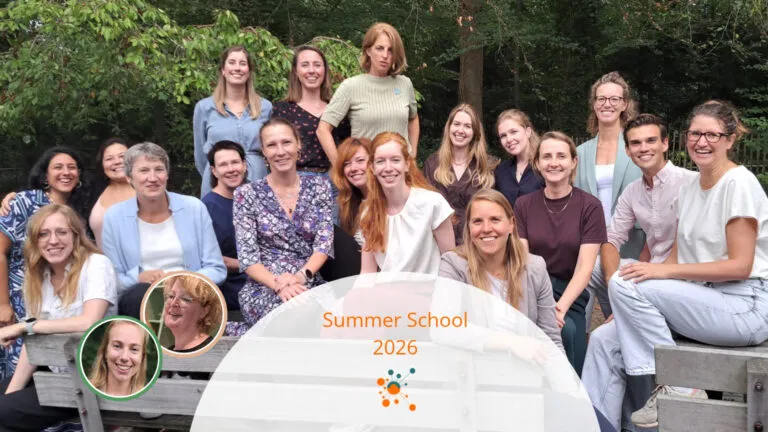
You spend years working on your research. But how do you ensure that the results actually bring about change in dementia care? It was with this question in mind that fourteen researchers attended the DEMPACT Summer School 2026 from 24 to 28 August. There, they spent five days focusing on a single thing: implementation.
DEMPACT is a partnership between Alzheimer Nederland, Movisie, Pharos and Vilans. It has a large network of organisations and experts who can help apply research findings in healthcare and social care practice. This was clearly reflected in the programme and organisation of the DEMPACT Summer School.
Vera Otten, Research Impact Adviser at Alzheimer Nederland, guided the participants through the five-day programme. “The 14 participants attended workshops, engaged in discussions with inspiring speakers about their implementation experiences, and worked hard on their own implementation plans.” The guest speakers included communication and implementation experts from Vilans, experts in the field of target group participation and inclusion from Movisie and Pharos respectively, and experts in public-private partnerships from Health Holland. On the final day, the participants presented their implementation plans to a jury drawn from DEMPACT’s network of experts.
[Video is in Dutch]
From a practical question to a knowledge product
On day three, Vilans organised the programme. Cynthia Hofman, Senior Research and Validation Officer, explained how a practical question develops into a useful knowledge product. She used examples such as ‘De Paarse Kaart’, the AI tool ‘InterventieZoekhulp’ and the project ‘Appropriate care and communication in hospitals’. The latter includes an animation full of blunders. It conveys just how uncomfortable a hospital visit can be for people with an intellectual disability. One participant found this particularly powerful: a knowledge product is allowed to be a bit uncomfortable.
For a senior researcher who had just completed a project, the Vilans programme shed new light on her own work. “I now understand how different knowledge products can be useful to different stakeholders at different times,” the researcher explains. “As a result, I suddenly realised that I have produced far more knowledge products than I had initially realised.”
Start the conversation early. And keep it going.
Sima Ipakchian Askari, a senior researcher and implementation expert at Vilans, shared her tips. Implementation plays a major role in many of her projects. Her hope is: “That researchers think about implementation even before their project begins. And that they develop knowledge products that are truly well-suited to real-world practice.”
One participant, who is undertaking PhD research, took that message on board. “Implementation is about starting early and having staying power,” she summarised. From her conversation with Ipakchian Askari, she learnt that you need to engage with all stakeholders at an early stage, and that you must continue to have those conversations throughout the project. She felt that the most important thing was that this approach works best for everyone. “If you create a win-win situation with everyone involved, everyone feels a sense of responsibility. I’ll be taking that insight with me into my next projects.”
Implementation is about networking
The idea that implementation revolves around relationships also resonated with one participant, a researcher at a university. “Collaboration is important, as are lasting relationships and enthusiasm. You need these if you really want to achieve practical implementation.”
Many participants were impressed by the experiences shared by researcher Dr Kay Deckers (Maastricht University). The lesson they took away: be bold and don’t let resistance hold you back. “Sometimes you hear ‘no’ nine times before you get a ‘yes’,” said Deckers. That requires staying power, and you can only maintain that if you believe in your own research.
Dream big, start small
Cynthia Hofman from Vilans kept hearing the same piece of advice: start small. “People are quick to think big,” she says. “That’s wonderful. But it’s also important to think in terms of achievable steps.” So dream big, and start small.
Funding for implementation. And more.
On the final day, all participants presented their implementation plans during a 5-minute pitch. The jury was full of praise and offered practical tips to help the participants take their projects even further.
Afterwards, participants with matching research projects indicated that they would continue to keep in touch. Others plan to make further contact with organisations that can help them take their research forward. During the week – using tips from one of the workshops – four of the participants wrote an application for the ZonMw ‘Implementation Impulse for Neurodegenerative Disorders’ grant. Not long after the Summer School, it emerged that these applications had been successful.
More reading (in Dutch)
- About the ‘Paarse Kaart’: vilans.nl.
- Visit the AI-tool interventiezoekhulp.nl
- About the project ‘Appropriate care and communication in hospitals’: vilans.nl.
- Check the LinkedIn-post on the ZonMw Grants: linkedin.com.
More inspiration