Public-private partnerships and independence? Yes, it’s possible.
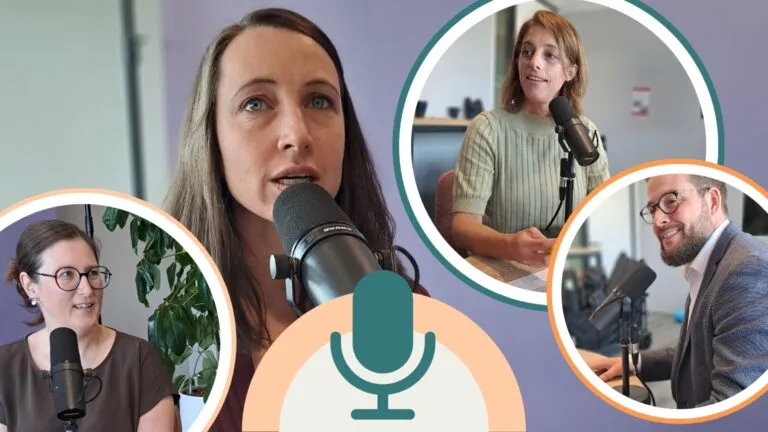
Collaboration between academic researchers and businesses can increase the societal impact of dementia research. But how does such a public-private partnership (PPP) work in practice? That is what this podcast is about.
Can your academic independence be maintained? What challenges are there, and how can you overcome them? And what exactly do PPPs deliver, for dementia research and academia itself? These questions are answered by Dr Inge Verberk, senior lecturer (Amsterdam UMC & the ABOARD consortium), and Dr Ann De Vos, head of business development (biotech company Fujirebio Europe).
Also joining the discussion are podcast hosts Dr Jeroen Vlug (senior researcher at DEMPACT partner Movisie) and Dr Saartje Burgmans (Impactmanager Business-development at DEMPACT).
Listen here via Springcast, Spotify or YouTube.
In a public-private partnership (PPP), a public and a private party work together towards a common goal, with shared responsibility and agreements on the sharing of risks, costs and revenues. Saartje Burgmans: “It’s about a long-term partnership, not a grant, sponsorship or one-off contract.”
In a PPP, the expertise of scientists is combined with the market knowledge, product development, financing and implementation expertise of businesses. As a result, a PPP not only provides insight into whether something works, but also into how it actually reaches people with dementia (and their loved ones) and care professionals. “That is why a PPP can bridge the gap between research and practice,” emphasises Burgmans.
ABOARD: 30 partners
What is the situation with ABOARD and Fujirebio? The ABOARD consortium is a partnership for dementia research comprising as many as thirty partners from the dementia sector. Various types of collaboration exist within the consortium. One of these is the public-private partnership between Amsterdam UMC and Fujirebio.
Dr Inge Verberk conducts research at Amsterdam UMC into biomarkers for the early diagnosis and prediction of the progression of dementia. Dr Ann De Vos is head of business development at Fujirebio Europe, a biotech company that develops, scales up and markets diagnostic tests.
Biomarkers for the early diagnosis of dementia
Together, ABOARD and Fujirebio aim to identify biomarkers for dementia diagnosis, develop clinical tests for this purpose, validate them and ultimately bring them to market. Inge Verberk: “Biomarkers are proteins or other signalling molecules found in the blood or cerebrospinal fluid. They allow us to draw conclusions about what is happening in the brain.” She hopes this will enable the earlier detection of diseases such as Alzheimer’s, Lewy body dementia or frontotemporal dementia.
Verberk: “In our neurochemical laboratory, we measure a wide range of proteins in the blood. We look at which protein changes in relation to which disease causing dementia, at what stage of the disease’s progression, and exactly what this signifies.” Verberk develops the hypotheses, carries out the scientific research, validates biomarkers using patient samples from the biobank, and publishes the results.
Ann De Vos: “Fujirebio’s contribution to the collaboration is those proteins.” Fujirebio produces materials that isolate the proteins from the blood, or sometimes from cerebrospinal fluid, in order to then effectively determine their concentrations. “Prototypes of the test, so to speak,” explains De Vos. “And if a prototype proves to be clinically valuable, we take care of scaling up, certification and preparing the test for clinical use worldwide.”
Fears
During the podcast, various issues are discussed that can hinder a public-private partnership (PPP). And how to prevent them. Top of the list: the fear that, as a researcher, you will lose your independence if you join forces with a commercial party. Is that fear justified?
“Certainly not in this collaboration,” says Verberk firmly. It turns out that the design of the research, the interpretation of the results and the rights to publish them lie entirely with Amsterdam UMC. “This way, we remain independent in our research. That’s what the legal contracts are for: they create scope for independent research.”
Keeping a close eye on things
Another fear: pressure from a company regarding the study design or publication. Or: that you share an idea too early, after which the company runs off with it. Seeking collaboration early on and then keeping a close eye on things is important in this regard, as Verberk’s account shows. She often takes PhD students along to meetings with companies so that they can learn the tricks of the trade. “In an initial meeting with companies, you can already sense whether you can trust them,” says Verberk. And what constitutes a red flag? “If you get the feeling that, as a researcher, you have to do what the company says, then you need to be careful.”
She explains that it sometimes happens that companies ask detailed questions even before a collaboration has been agreed. “In that case, you’re effectively advising commercial parties, and you should be paid for that – for example, through a consultancy contract.”
Mutual trust
None of this is an issue with Fujirebio. And that’s not just down to good contracts. This partnership has a long history. Verberk: “It takes time to stabilise a partnership like this and build up the sort of mutual trust you can rely on. We have that sort of relationship with Fujirebio.”
Ann De Vos: “We know that investing in very early-stage research sometimes pays off – but usually doesn’t. We’re willing to take that risk. The advantage of our long-standing partnership with ABOARD is that when Inge and her team pitch something to us, we’re quicker to take the plunge, because we know: there might be something in it.”
Equal contracts
Trust also develops when both parties stand to gain and this is set out in the contract, adds Ann De Vos: “It’s better to set up an arrangement that benefits both parties; otherwise, it can never last in the long term.” A significant part of her work involves drawing up equitable contracts with clear agreements on commercialisation and royalties.
Royalties for research
At ABOARD and Fujirebio, the arrangement is such that the company has the right to commercialise joint results; royalties from sales are channelled back to Amsterdam UMC for investment in new research.
The collaboration has already yielded several biomarkers that are currently in development or have already been brought to market. Examples include a blood test for Alzheimer’s (phosphorylated tau217), a test for Lewy body dementia and research into acetylated tau for frontotemporal dementia. The collaboration also resulted in a publication in *Nature Medicine*.
Reluctant to disclose details
When asked for advice for fellow researchers, Verberk reiterates that it is important to start building collaborations early on and to invest in trust, whilst remaining vigilant. Verberk: “When presenting your research at conferences, be cautious about sharing sensitive details.”
Involve experts
Another tip: “Involve business developers and Principal Investigators in discussions with companies and ensure agreements are legally documented.” This way, you can safeguard academic independence whilst ensuring fair remuneration for commercial activities.
About the speakers
- Inge Verberk: linkedin.com/in/inge-verberk/
- Alzheimercentrum Amsterdam UMC: alzheimercentrum.nl/
- Nature Medicine publication: nature.com/articles/s41591-026-04341-6
- Ann De Vos: linkedin.com/in/ann-de-vos-5bb3866/
- fujirebio.com/en/about-fujirebio
More inspiration