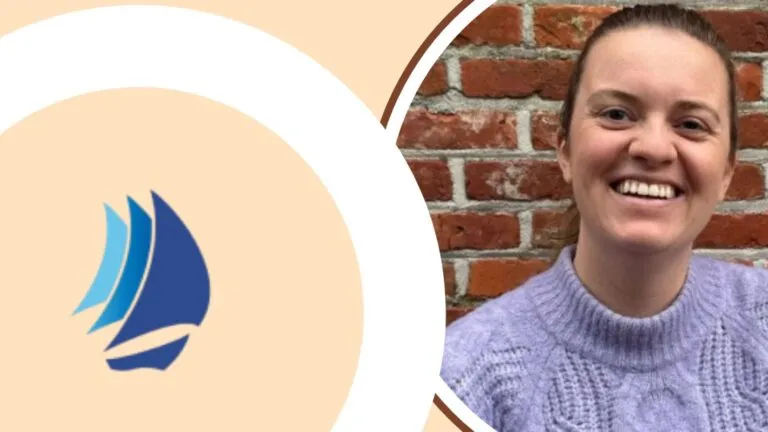
“First, I write down whatever comes to mind. Then I polish it.”
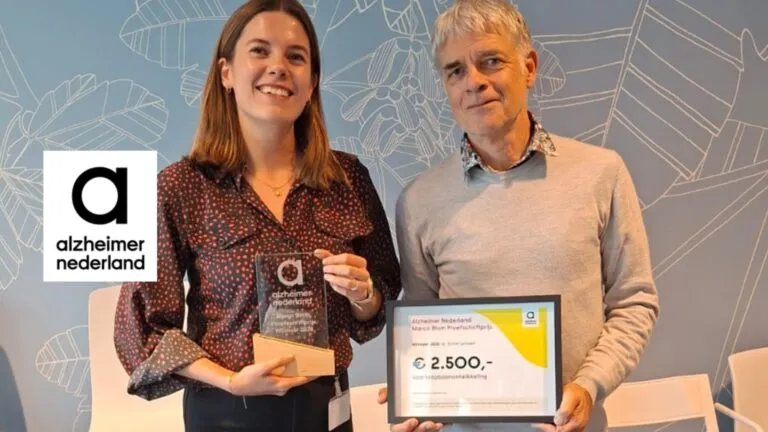
She thought she had an appointment with her thesis advisor, but once she arrived on site, Dr. Esther Janssen (Radboudumc) was given a festive welcome by her colleagues and Alzheimer Nederland. Marco Blom (former head of scientific research) presented her with the 2026 Marco Blom Dissertation Award (‘Marco Blom Proefschriftprijs 2026’). “I was completely surprised. And very happy.”
The Brain Under Pressure
Janssen won the award for her thesis abstract titled “The Brain Under Pressure: The Hidden Damage of High Blood Pressure.” High blood pressure increases the risk of dementia, but exactly how that works is not yet known. Nor is it clear how early brain damage caused by high blood pressure becomes visible. Janssen therefore used MRI scans to examine the brains of people in their thirties, both with and without brain damage. It turns out that high blood pressure already causes more brain abnormalities at that age, as well as a less effective blood-brain barrier. After defending her dissertation last June, Janssen received many compliments on her layman’s talk. That inspired her to enter the dissertation prize competition.
Powerful Metaphor
Alzheimer Nederland awards this prize annually to the researcher who most clearly summarizes their dissertation for a broad audience. Four finalists were selected from 11 entries: Amber Boots, Simon Braak, Esther Janssen, and Jasper Smits.
Janssen emerged as the winner because, according to the jury, her summary quickly clarifies what the research is about and makes it easy to understand why her research is important. Janssen also made effective use of a metaphor: she compares streets and alleys in the city to blood vessels in the brain and describes what it looks like when those streets are blocked.
Writing Secrets
DEMPACT called Janssen and asked her: What’s your writing secret? “Practice a lot,” Janssen says immediately. “It also helps that I’ve always enjoyed writing.” She’s happy to share her experience and tips with fellow researchers.
Tip 1 Take Your Time
“Sometimes it takes a while to get into the flow of writing. That’s why I always make sure to set aside plenty of time for it: I prefer to block off an entire day beforehand. And I focus: I turn off my email and put my phone on silent.”
Tip 2 Write whatever comes to mind
“For a first draft, I write whatever comes to mind. I usually start with the research objective and the findings. And how we arrived at those findings. Then I start refining it: is the story structured logically? Only once the content is solid do I look at the exact wording and craft it into beautiful sentences.”
Tip 3 Take a Break
“If I do get stuck somewhere, I often let it go for a while. Then I move on to a section I can work on. That helps me get back into it. And when things are going well, I pick up the part I was struggling with again.”
Tip 4 Have non-experts read along (and: persevere)
“It’s very educational to have people around you read along. Not your colleagues, but your partner or family. It can be tough when someone points out that a certain explanation is incomprehensible, especially if you’ve worked really hard on it. But you learn a lot from that. So just persevere.”
Read more
Dr. Esther Janssen’s thesis, “The Brain Under Pressure”: books.radbouduniversitypress.nl.
News article about this award on Alzheimer-nederland.nl.
Lees meer
- Thesis dr. Esther Janssen ‘The Brain Under Pressure’: books.radbouduniversitypress.nl.
- News article about this prize on Alzheimer-nederland.nl.
More inspiration