“Be an active player in healthcare, education and science.”
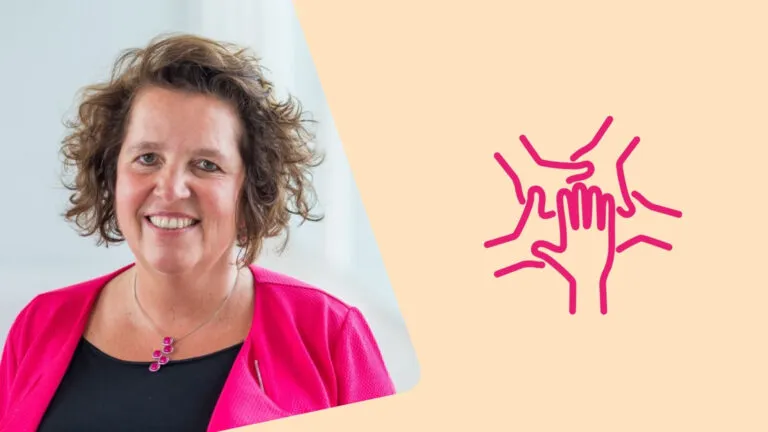
If you ask around about successful implementations, you’ll often hear: Occupational Therapy for Older People with Dementia and their Informal Carers at Home (‘EDOMAH’). But what made this programme so successful? Prof. Maud Graff, who was one of the founders of EDOMAH, reflects on this. One of the success factors: structured collaboration with clinical practice and education.
The EDOMAH programme is an occupational therapy guideline for the diagnosis and treatment of older people with dementia and their informal carers. It includes theoretical underpinnings, interview and observation tools, case studies and videos. What makes this programme unique is that, in addition to the needs of the older person with dementia, it also focuses on those of the informal carer.
Proven effectiveness
Both the EDOMAH programme and its implementation have been highly successful. Three scientific publications have demonstrated the (cost) effectiveness of EDOMAH. And the treatment saves a huge amount in care costs, according to calculations by the independent Social and Economic Research Bureau: every euro spent on EDOMAH occupational therapy saves eleven. In the Netherlands, over a thousand EDOMAH occupational therapists have now been trained. Many more have been trained in five other European countries as well.
EDOMAH was launched in 1996. At that time, the national working group on Occupational Therapy & Geriatrics proposed developing a treatment (based on the literature and consensus) for people with mild to moderate cognitive impairment and their informal carers. The aim was to enable them to continue engaging in meaningful activities for longer, thereby enhancing their quality of life and allowing them to live at home for longer in a comfortable way – which also benefited their carers. Maud Graff, at the time an occupational therapist, researcher and member of the working group, set to work.
"Just seeking advice now and then isn’t enough"
Almost thirty years later, Graff is not only an occupational therapist, researcher and lecturer, but also a professor of Occupational Therapy and an expert in the application of the guideline. Ten years after the first guideline was published, she completed her PhD based on studies into the feasibility and (cost) effectiveness of the EDOMAH programme. Since then, she has supervised various national and international, mono- and interdisciplinary EDOMAH implementation and evaluation studies. “Implementation begins at the same time as your research,” she states. “It is a form of structural collaboration with both practice and education, which must be interwoven with your research. Simply seeking advice from time to time from a professional in practice or education is not enough.”
Wide-ranging collaboration at every stage
Collaboration was extensive. Together with the Amsterdam University of Applied Sciences, Graff adapted interview and observation tools – drawn from the American Model of Human Occupation – to the Dutch context and specifically for people with dementia and their informal carers; this became the baseline model under the EDOMAH guideline. Furthermore, Graff tested and refined parts of the intervention in collaboration with practitioners: both at Radboudumc and nationwide.
She organised consensus-building sessions and consultations on these matters through an interdisciplinary steering group. This group comprised occupational therapists, people with dementia (and their relatives), researchers, guideline developers, lecturers, psychologists, nurses and social workers. The results were compiled into an initial version of the EDOMAH programme (1998), which comprised a guideline, theoretical background, videos and other tools to support practice. Together with the EDOMAH team at Radboudumc and lecturers, Graff developed post-HBO training for occupational therapists. A small group of practitioners, as well as students and lecturers, subsequently took part in a usability study. Following this, the guideline was revised once again. “The current EDOMAH team largely retains the same composition and now functions as the EDOMAH steering group.”
The roll-out of the EDOMAH programme in practice has taken place in stages (since 1999): from local to national and international levels. Structural collaboration was essential for this too.
“For implementation, you must be – and remain – an active player in the healthcare sector, education and academia,” emphasises Graff.
"You need to find people with their feet firmly on the ground"
In other words: imposing something new from above doesn’t work. “You need to find the people with their feet firmly on the ground. And find a willingness amongst them to innovate together and develop implementation strategies. Together, you then pass this on to professionals elsewhere in the region. They can then do it themselves. That way, the process continues even after the researcher has left.”
EDOMAH has regional expert groups for the dissemination of knowledge and the exchange of practical experience. These are in turn represented in a national expert group, which meets twice a year with the EDOMAH steering group. “The practical experiences from the expert group inform the steering group. And the steering group shares the latest knowledge from the worlds of science and education with the expert group.”
Local coordinator leads the scaling up of an interdisciplinary approach
A local network coordinator, working alongside regional EDOMAH experts, can lead the implementation and scale it up step by step. “For implementation, you need to bring together relevant professionals from different disciplines who are also experiencing the problem you are solving, who endorse your intervention, and who are willing to help implement it.” Such a coordinator oversees this process, whilst connecting local and national networks by participating directly and engaging relevant interdisciplinary professional groups. Sometimes EDOMAH experts act as coordinators themselves.
Regional experts regularly ask Graff whether a national expert would like to give a presentation. But Graff declines. “They’re better at doing that themselves. They know the people, the region, the customs and the language. This enables them to present in a tailored way and within the local context: people are more likely to accept something from them. Moreover, it strengthens their position as experts and process owners.”
Included in study programmes
EDOMAH has been incorporated into Dutch post-HBO education and international Master’s programmes for many years. EDOMAH is also included in Occupational Therapy degree programmes, thanks to coordination between Graff and the education expert from the steering group with the relevant degree programmes. All study programmes are constantly evolving. There is a national network of EDOMAH coaches who support newly qualified practitioners. There is also an international network of EDOMAH lecturers and researchers.
Various EDOMAH-based interdisciplinary care programmes have been implemented. Implementation research is also being carried out within the interdisciplinary care and welfare networks. Graff oversees all implementation research and processes. It bases its approach on scientific evaluations and knowledge gained from previous implementation research. “We are constantly nurturing the EDOMAH experts. After all, people keep coming back if there is something to be gained or something to be learnt.”
Copy and paste? Don’t do it
When expanding or scaling up an implementation, simply copying and pasting a successful collaboration model is not a good idea, emphasises Graff. “Always start with a context check. Who are the local stakeholders? Where are the points of entry into the networks? Might you need to adapt your approach slightly to the culture, the language or regional customs?” In every local authority, for example, healthcare is organised differently. And networks operate differently. And a cultural difference between North Holland and Limburg, for instance, affects communication between healthcare providers. Graff: “You need to take that into account.”
Rationale: solving practical problems
Graff is surprised that social science research is still being carried out without a structural link to practice. A problem is then distilled from the literature, for which someone devises a solution. “You need to know what’s going on in practice,” says Graff. “The raison d’être of social science (intervention) research is that the question arises from practice, and you help to solve practical problems.”
More inspiration