"Pruning encourages flowering"
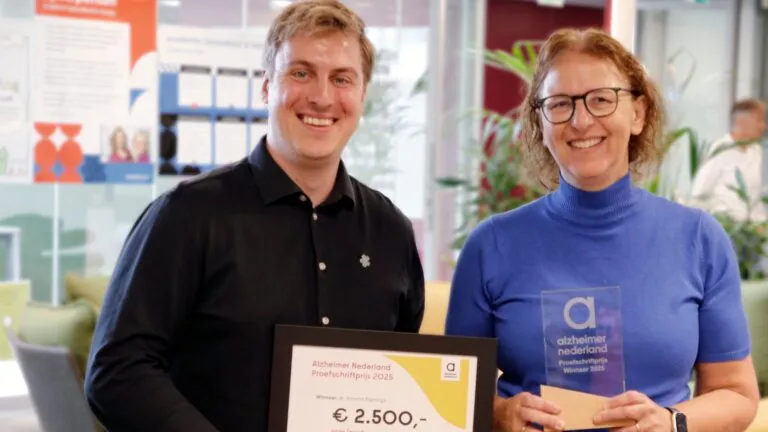
From 21 entries, a panel of experts selected Dr Annette Plantinga’s abstract: her text was the clearest and most accessible to a wide audience. Where did she learn that? And what advice does she have for other dementia researchers?
For her PhD thesis, ‘Dementia care in Dutch hospital settings: perspectives on person-centred Nursing care and shared decision-making’, Dr Annette Plantinga gathered experiences from nurses and informal carers. These experiences centred on person-centred care for people with dementia whilst they were hospitalised. She was awarded her PhD for this work at the University of Groningen at the end of 2024. As a lecturer-researcher at NHL Stenden University of Applied Sciences (Leeuwarden), Plantinga conducts research into healthcare practice.
According to the expert jury, the summary of her thesis is clear and easy to read, as Plantinga used short sentences and paragraphs. She also structured the text well and provided clarity with effective section headings. Furthermore, Plantinga was able to explain vividly why a hospital admission can be so distressing for people with dementia.
DEMPACT rang Plantinga to congratulate her and ask for some advice straight away.
What advice do you have for dementia researchers who want to write in an accessible way?
“Actually, four things. First, consider what message you want to convey. For researchers, this often means: start at the end, because that’s where we usually write our conclusion. So that’s where you should begin in texts aimed at the general public.”
"In addition, my supervisor’s motto applies: pruning is flourishing. Make choices about what you want to say. In my summary, for example, I left out the fact that I’d also carried out validation research; I felt this would be of less interest to the general public."
"That brings us to the third point: think very carefully about your audience – get to know your target group. I wanted the summary to be understandable to the loved ones of people with dementia, who are usually elderly. That’s why I kept my own parents in mind: what and how would I tell them about it?”
"I never just start writing. Once I’ve clarified the message, I first write down a key sentence for each paragraph, or the paragraph headings, for example. That provides a framework, a logical structure leading up to the message."
"Think about the message you want to convey. Make clear-cut choices. Get to know your target audience. And structure your text logically."
Where did you learn this?
“Well, it’s a combination of experiences. I used to be a nurse; in that role, you have to communicate with people at all levels. And in my work as a lecturer and researcher, too, I’m always asking myself who I’m dealing with and what their level of knowledge is. I don’t even consider myself a very good writer. For example, I much prefer talking about my research. But that turns out to be good practice for writing clearly.”
What do you ultimately hope to achieve?
"It’s my personal mission to improve care for vulnerable older people, including those with dementia. I know from experience that this care can be better. My grandparents had dementia. And I’ve worked as a nurse myself."
What are you going to do with the prize money – 2,500 euros for career development?
"I’d like to spend it on a course on implementing new solutions in healthcare practice. There are plenty of such solutions available, after all. But they’re often not put into practice. That’s a shame."
More inspiration