"Let vocational students get stuck in."

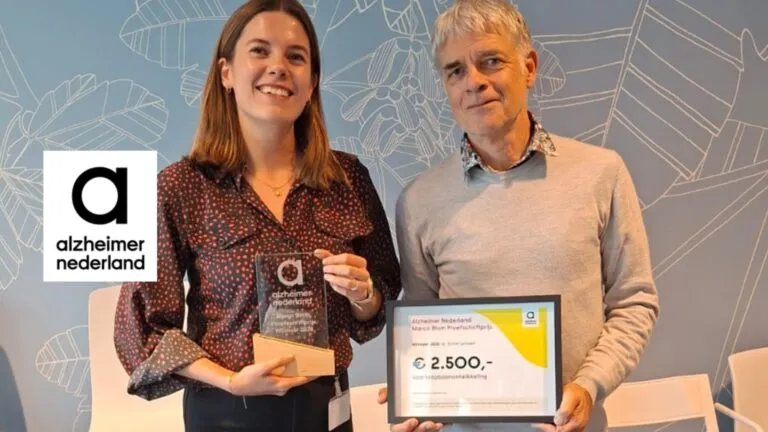
Carlijn Lensink, Impactmanager Education and a DEMPACT member from the very beginning, is leaving. To raise awareness of dementia in education, she brought dementia research together with (primarily) vocational care and welfare programmes. Before she leaves, she’s sharing her insights and tips with you.
There wasn’t exactly a roadmap in place when Carlijn Lensink joined DEMPACT in 2024. But Lensink, a born networker, started “where the energy was”. By exploring needs, unearthing good examples, organising meetings and driving collaboration. A selection of her findings:
- We now have a clear picture of how vocational, higher vocational and university curricula are developed (“Through three different, complex decision-making structures.”) And what the need is for education on dementia (“It’s significant.”)
- Alzheimer Nederland has started to fund practical research within vocational education (the so-called ‘practorates’), partly thanks to input from Lensink.
- An online Dementia Education Think Tank was established, to which 30 vocational education professionals are now affiliated. Dementia researchers engage in discussions with them during online meetings; topics include how to translate research findings into suitable teaching methods.
- A list of recommendations for strengthening vocational training programmes for Care Workers and Nurses, centred on: better preparing students to work with people with dementia and focusing care more on the person and their wellbeing, rather than on the disease.
What stands out most when you look back?
“The drive. Both dementia researchers and education professionals recognise the importance of greater dementia knowledge in vocational care and welfare programmes. This is hardly surprising, given the pressing situation. However, ensuring that academic knowledge is adapted for vocational education is very challenging. That is why collaborating with education experts is so important.”
What are your tips for dementia researchers?
Tip 1: Set a realistic goal
"I’ve often seen researchers aim to ‘include X in the curriculum’. In reality, that means amending the Qualification Framework: that’s unfeasible for such a specific topic. A more realistic approach would be, for example: ‘Working with an educational institution, translate knowledge X from my research into a practical teaching method’."
Tip 2: Check – does your knowledge fall under a broader umbrella?
“Another tip: vocational training programmes, such as MBO healthcare and social care, only incorporate general knowledge under a broader umbrella. You need to be aware of this if you want your knowledge to be included.”
"Example: a healthy lifestyle helps to reduce the risk of dementia. But teaching materials on this subject won’t be accepted. This is because lifestyle knowledge falls under ‘general prevention’ in both MBO and HBO. At best, you might manage to get a supplement added: ‘A healthy lifestyle helps prevent cardiovascular disease, diabetes, obesity and dementia.’
"Topics on which, incidentally, there is still very little teaching material available, but for which there is a great need: dealing with behaviour that is not understood, interpersonal skills and person-centred care."
Tip 3: Forget reading. Get vocational students to do something
“Also very important: reading material such as long reports isn’t well suited to vocational education. So choose other forms of learning. Above all, let vocational students get stuck in. This requires you, as an academic, to make a significant shift in approach and to collaborate closely with educational practitioners.”
Tip 4: Organise your success: involve educators from the outset
"You can’t make that sort of adaptation from behind your academic laptop. Collaboration is absolutely essential. Preferably from the moment you realise that your findings need to be applied in education."
"Don’t walk in saying ‘this is what you need to do’. Instead, first explore the challenges faced by the institution’s education professionals. Spend a day shadowing students – both at the institution and on a work placement. Then see where those gaps in teaching overlap with what you have to offer. And from there, work together to translate your findings into concrete, practical knowledge.”
"Wellbeing isn’t just a bonus. It determines the quality of life. That’s why it’s important for healthcare and wellbeing services to focus on it."
Just a quick question: what’s the big deal?
"80 per cent of students on vocational training programmes in Care and Nursing come into contact with people with dementia. However, dementia is not included in the Qualification Dossier, the statutory educational guideline for this vocational sector. This is partly because dementia care in nursing, care work and home care is regarded as low-complexity. That is unjustified. Dementia care requires sensitivity, interpersonal skills, clinical reasoning and safety, for example."
"Students going on work placements are expected to care for confused people with dementia without proper preparation, or to deal with disinhibited behaviour or aggression. This takes them by surprise. This is one of the reasons why drop-out rates are high."
"At the same time, there is a genuine need for more staff and greater focus on dementia within the care and welfare sectors. The number of people with dementia is rising dramatically, from 320,000 today to over 500,000 by 2040. Three-quarters of them will be living at home. At the same time, four in ten healthcare professionals working in dementia care are considering leaving the profession. Three-quarters of them feel that the work has become more physically and mentally demanding.”
So what needs to change in healthcare education?
"Researchers and education professionals say: from now on, healthcare education should be based on the principle that care must focus on the person and their wellbeing, rather than solely on the disease. It follows that we must teach vocational students different things: more practical skills, self-reflection and collaboration with relatives and other disciplines."
“It is also time we recognised vocational college professionals as experts who know what to do in complex situations: they encounter people with dementia far more frequently and understand them better than colleagues from higher professional education or university.”
Sessions with researchers and education experts
This follows from sessions with researchers and professionals from the care and welfare sector (including vocational education), which Lensink organised on behalf of the Consortium BO foundation (which produces teaching materials and exams) and the non-profit co-operative Prove2Move (which produces exams and assessment training courses). The impetus for this was the revision of the so-called Body of Knowledge (or BoK), a tool for fleshing out the Qualification Dossier. Every four years, the dossier is updated first (including in 2025), followed by the BoK.
“For the revision of the BoK, we have drawn up specific recommendations concerning the identification of psychosocial aspects, dealing with misunderstood behaviour, cultural diversity, the use of technology in the home environment and meaningful daily activities.”
“Of course, some content will need to be removed. Knowledge of research methods is of little use to vocational college students; understanding how the diagnostic process works is far more important. The same applies to specialist knowledge of diseases and the pathophysiology of all forms of dementia; what is particularly important is knowing that there are different forms. Being able to observe, identify and approach situations effectively is far more important for care providers than knowing exactly which behaviour corresponds to which subtype of dementia.”
Want to find out more?
- The series *Zorgen* follows students on an MBO care course; during his work placement, Kenny has to care for people with dementia, and it’s tough going: youtube.com.
- Enabling People with Dementia: Understanding and Implementing Person-Centred Care, Springer.com.
- Learning and developing together for person-centred care, a study by the Trimbos Institute: trimbos.nl (pdf).
More inspiration