"Spending a day shadowing someone provides a wealth of insight."
Together with the Nederlands Geheugenpoli Netwerk (NGN) and Vilans, Akke Ariesen (Impactmanager Healthcare at DEMPACT) is exploring how to best ensure that relevant research for memory clinics is put into practice. This includes research into diagnostics, inclusive care, early-onset dementia or support following diagnosis.
Ariesen: “As a general rule, if you’re introducing something new – such as research or innovation – a prerequisite for success is that you tailor it to the environment and the users.” For memory clinics, this means you need to understand what the care pathways look like. When do people with memory problems undergo which tests and consultations? When do they receive which support? But also: which healthcare professionals are involved? “So you need to identify exactly which step in the process you want to improve. And: which professionals are specifically involved in that.”
“Shadowing provides a wealth of insight.”
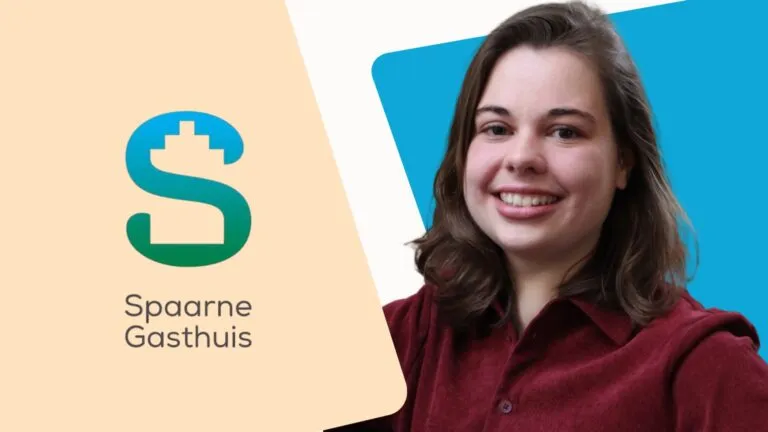
To find out how to do this, Ariesen wanted to shadow staff for a day herself. She was able to do so at the Memory Centre of the Spaarne Gasthuis Haarlem, a specialist hospital. This is a peripheral hospital but one that is closely involved in various dementia studies, including DemenTREE, Bridge-AD2 and TAP-TAU.
Her experience immediately provides an initial tip for dementia researchers. “Spending a day shadowing provides a wealth of insight into the context in which you want your results to be applied. I therefore recommend this to anyone who wants to apply their findings in a memory clinic.”
“NGN can assist with implementation”
Through on-site discussions, Ariesen also quickly discovered the most complex aspect of implementation in memory clinics. “Every memory clinic is organised differently, with different care pathways and roles for healthcare professionals.”
Are there, then, any starting points for dementia researchers who want to apply their work in memory clinics? “Definitely. The Nederlands Geheugenpoli Netwerk plays an important role in this and can help you.” Her tips:
- Involve a specific memory clinic before you finalise your research process; you can do this via the NGN.
- Spend a day shadowing the team.
- Tailor your research process to that memory clinic and, in due course, implement your findings there as a pilot scheme.
- If your research findings do indeed prove to be a practical improvement, scale up to several similar memory clinics, in consultation with the NGN.
- Only then should you begin working on a nationwide roll-out.
How Spaarnegasthuis works
What did Ariesen note specifically about the Spaarne Gasthuis Memory Centre? Among other things, that the Memory Centre has three care pathways (see also spaarnegasthuis.nl).
- The standard care pathway is for people aged between 65 and 75 who may have dementia.
- A care pathway for younger people with suspected dementia (under 65).
- A culturally sensitive care pathway for people from migrant backgrounds or with specific adaptation needs.
“A culturally sensitive care pathway is not yet the norm,” says Ariesen. “The Spaarne is truly leading the way in this respect.”
Which healthcare professionals?
Which healthcare professional you see when you are referred to Spaarne Gasthuis depends, amongst other things, on your age. People under the age of 65 will speak to a cognitive neurologist during their first appointment at the Memory Centre.
People aged 66 to 75 with memory problems will see both a neurologist and a geriatrician. Anyone over the age of 75, or those with multiple health problems or a history of mental health issues, will have their first appointment with a geriatrician; if necessary, this will be followed by a referral to a cognitive neurologist.
Tailored care above all
“This sounds very by-the-book,” says Ariesen. “But during my visit, I noticed that in practice, care is primarily tailored to the individual.” For each patient, a assessment is made of which tests, healthcare providers and support are required.
7 steps
Broadly speaking, following a referral to the Memory Centre, people go through seven steps – adapted as necessary to provide a personalised approach:
- Prior to the first appointment, patients complete questionnaires at home (including the HADS and IADL, which measure a person’s mental health and independence in daily life, respectively).
- During the first appointment, the neurologist and/or geriatrician discusses the memory problems, daily functioning, mood, behaviour and physical health in detail. Generally, a family member or carer is also present to provide information.
- During that first appointment, the neurologist also carries out a neurological examination and brief cognitive tests. At the end of the consultation, the patient is informed of any follow-up investigations required (cognitive screening tests, an MRI scan or blood tests, if these have not already been carried out).
- The cognitive screening comprises the Seven Minute Screen (to detect Alzheimer’s), the Frontal Assessment Battery (which tests the functioning of the frontal lobes) and the MOCA (which measures cognitive decline); a nurse conducts this screening under the supervision of a clinical neuropsychologist.
- The results of all the investigations are first discussed by a multidisciplinary team (neurologists, geriatricians, neuropsychologists, nurses and psychiatrists); together, they determine what further steps are required.
- The neurologist or geriatrician then discusses with the person who was referred whether any further investigations are required (such as PET scans, (more extensive) neuropsychological assessment and/or a lumbar puncture).
- A consultation to discuss the results takes place once all the investigations have been completed; during this, the neurologist or geriatrician discusses the treatment plan with the patient and their loved ones.
Young people with dementia
Ariesen: “For young people with dementia, there are additional consultations with the nursing specialist immediately following the diagnosis.” These cover, amongst other things, aftercare and any medication. One month after the results consultation, this nurse will see the patient and their next of kin again. After four months, they will have a follow-up consultation with the neurologist.
Noteworthy: aftercare following diagnosis
The Spaarne Memory Centre pays particular attention to the period following diagnosis. Ariesen: “This is one aspect that varies greatly between memory clinics. Aftercare following a diagnosis does not always take place at the memory clinic.” In the culturally sensitive care pathway and that for young people with dementia, there is more extensive support from the clinical neuropsychologist. This includes psychoeducation, family consultations and support for carers.
Nursing specialist and case manager
In the care pathway for young people with dementia, follow-up care is partly the responsibility of the nurse specialist. They are involved in psychoeducation, discussing test results and supporting young people with dementia following diagnosis. For example, the nursing specialist keeps a close eye on how the diagnosis has been received and whether there are any questions. People with dementia are also linked to a case manager immediately after diagnosis, so that the transition to further support runs smoothly.
The nursing specialist also actively highlights the opportunity to take part in scientific research. Ariesen: “The Memory Centre at the Spaarne Gasthuis shows that even peripheral hospitals can be heavily involved in research.”
More inspiration